Traditional change management assumes one person changes one thing at a time, while AI agents run many attempts in parallel and discard most of them. Change management for agents needs isolated tasks, automatic build and test, AI judges, human approval and a full audit trail.
Side by Side
| Built for people | Built for AI agents (CoderFlow) | |
|---|---|---|
| Unit of work | One developer, one change | Many agents, many parallel attempts |
| Testing | Depends on the developer | Automatic build and test before review |
| Choosing a result | There is only one | AI judges compare attempts and explain the winner |
| Approval | Manual promotion steps | A human approval gate on every change |
| Traceability | Who typed the change | Request, agent, instructions, reviewer and approver |
| Source control | Often outside Git for older code | Git-native, with an incremental path in |
Why the Old Model Breaks
Most change processes were designed around one person checking out code and promoting it through levels. Agents try several approaches at once, throw most away and must prove their work before anyone looks, so that process either slows them down or lets risk slip through.
What Change Management for Agents Needs
Every change should link back to the business request, the agent, its instructions and the approver.
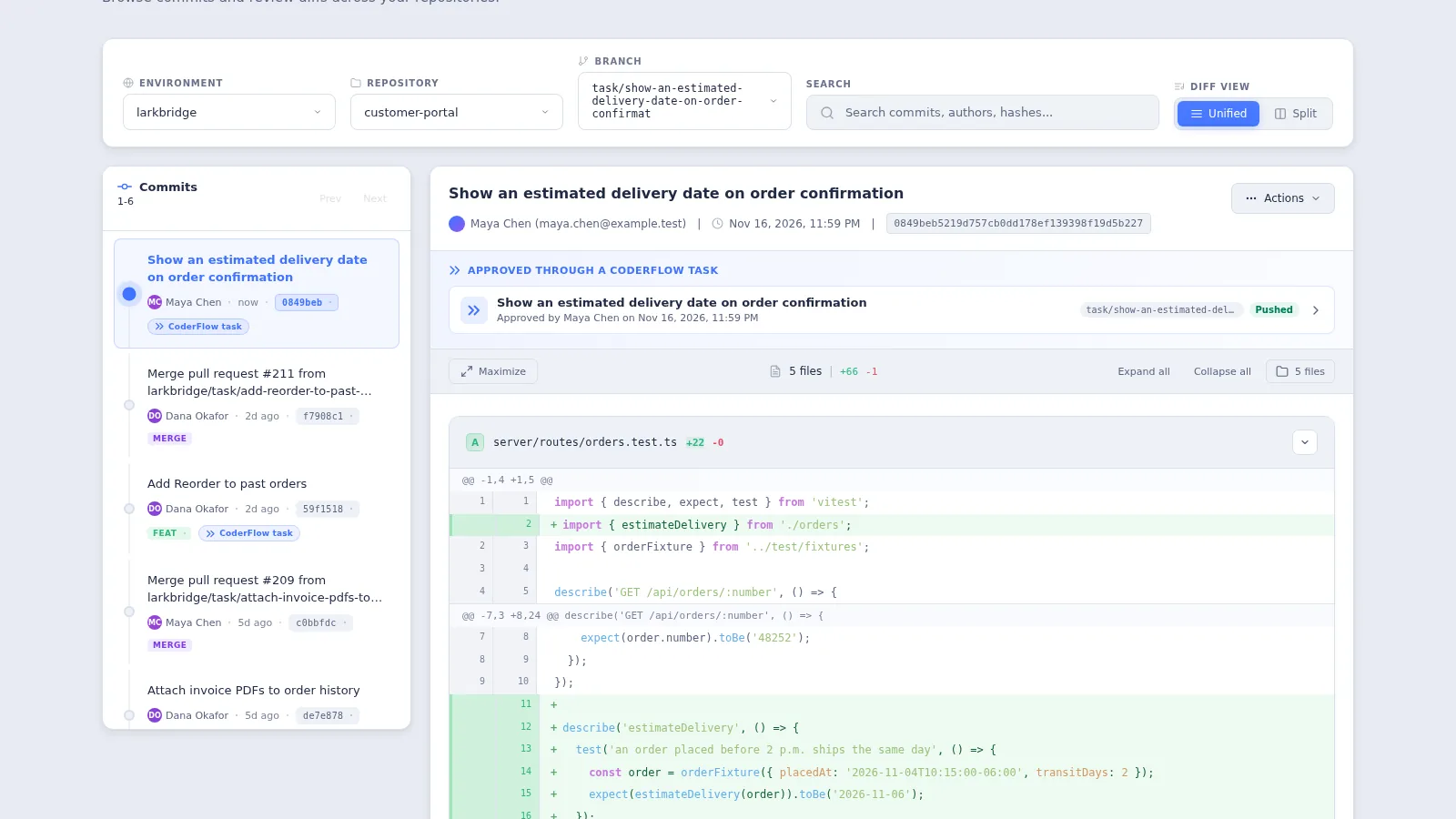
- Isolation: every task in its own container, so parallel work never collides.
- Proof before review: builds and tests run automatically.
- Selection: AI judges compare attempts and explain which is best.
- Control: nothing ships without human approval.
Getting Existing Source Ready
Many custom systems have never been in version control. Bring source into Git incrementally, starting with the parts you change most, with normal Git tools or plain-text uploads.
Questions
Do Humans Still Approve Changes Made by AI Agents in CoderFlow?
Yes, always: a person reviews the diff, test output and screenshots before approving a commit, a branch or a pull request. Roles decide who can approve and deploy.
How Do We Prove Who Changed What When AI Agents Do the Work?
CoderFlow records who approved each change, when, and the commits per repository. The full task history is kept after the container is removed, and IT Requests link a change to the business user who asked.
Can CoderFlow Roll Back a Change After Deployment?
Partly today, with more coming. Every approved change is a Git commit you can revert, and deployment profiles run the release and back-out scripts you define.