
The question IT leaders keep asking is "Should we adopt agentic coding?" The better question is how to capture the gains without putting the systems the business depends on at risk. Most agentic tools are built for cloud-native startups, so closing that gap takes agents that work inside your infrastructure, deliver verified results and stay under human review and audit.
Beyond the IDE
Agents such as Claude Code, Codex and GitHub Copilot's coding agent now make the change, run the build and the tests, and fix what fails. The bottleneck has moved from writing code to everything after it: testing each change against your systems, reviewing, approving and releasing it. In Faros AI's vendor data from 22,000 developers, median time in review rose 441.5% as teams moved to high AI adoption (Faros AI, April 2026).
So the center of gravity moves from the editor to the orchestration layer: defining the work, directing agents, checking their output and choosing the best result.
Why the Companies That Need It Most Are Left Out
Many agentic coding tools assume a GitHub repository, microservices and a comprehensive test suite, not a manufacturer running COBOL, an insurer on PowerBuilder or a utility on Oracle Forms.
These organizations run decades of business logic under audit requirements, yet need the gains most as experienced developers retire and backlogs grow. That is the agentic coding paradox.
What Enterprise Agentic Coding Requires
- Execution inside your infrastructure. Agents work on your real code, data and rules.
- Governance and transparency. Every action is logged, auditable and reversible.
- Parallel execution with evaluation. Several agents try different approaches, compared by automated checks and AI judging.
- Verified outcomes with evidence. The result is built and tested where your platform allows, ready for review, not debugging.
What CoderFlow Does Differently
CoderFlow can run entirely inside your infrastructure, with agents in isolated containers that have access to code, databases and services. What an agent reads goes only to the AI provider IT configured, such as Claude, OpenAI, Google Gemini, your own gateway or a self-hosted model.
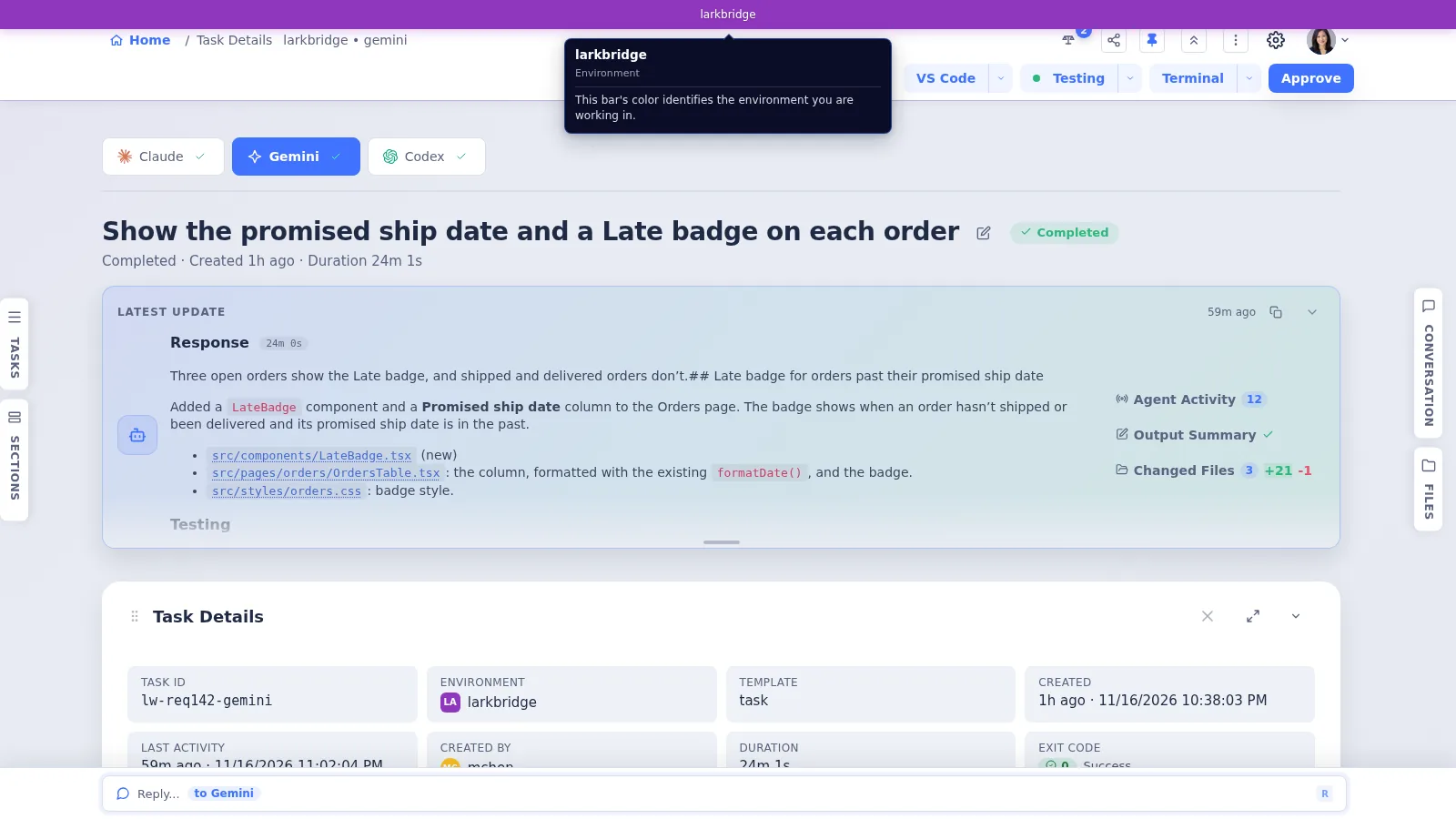
From COBOL and Oracle Forms to VB6 and Delphi, agents build and test with your toolchain where it is available, or prepare changes your team builds and tests. AI judges compare parallel results, and a person approves every outcome before it is committed. Learn more on the platform page.
Customers use it to refactor code, move data access to SQL, reimagine screens and document COBOL at scale, and report 5 to 10x developer productivity without adding risk.
The Path Forward for IT Leaders
- Treat it as a new operating model. The change is in how work gets tested, reviewed and released, not only how fast code gets written.
- Be honest about prerequisites. Agents need source control, a way to build and a way to test. If your source is not in Git yet, start there.
- Start with a bounded pilot. Prove one workflow, such as documentation or unit tests, before expanding.
- Measure outcomes. Track time from task to approved commit, not lines of code.
The Real Question
The technology exists, and the gains are real. The only variable is how quickly you learn to capture them while keeping the stability, security and governance the business requires. Talk to sales or start with a Reimagine engagement.
Questions
What Is the Difference Between Agentic Coding and an AI Coding Assistant?
Agentic coding means the AI completes the task, not just a piece of code. CoderFlow runs agents such as Claude Code and Codex in isolated containers set up like your systems, where they make the change, build and test it where your toolchain allows, and return a diff a developer approves before anything is committed.
Can Agentic Coding Work on Older Custom Systems Like COBOL, PowerBuilder or Delphi?
CoderFlow agents build and test changes in an isolated container per task wherever the toolchain runs in its Linux environments or on a remote build host connected over SSH. For Windows-only toolchains such as PowerBuilder, agents prepare changes your team builds and tests.
What Does an IT Leader Need in Place Before Adopting CoderFlow for Agentic Coding?
Source in Git, a way to build and a way to test. CoderFlow itself needs a Linux server with Docker (or hosting by Profound Logic), outbound internet access and an account with at least one AI provider such as Claude, Codex or Gemini.