
OpenVMS With CoderFlow
COBOL, Fortran, BASIC and Pascal applications held together by DCL procedures.
Start with one defined workflow on the systems you already run, then expand as it proves itself.
$! NIGHTLY_CLOSE.COM - end-of-day order close
$ SET NOON
$ RUN SYS$APP:ORDCLOSE
$ IF $STATUS .NE. %X00000001
$ THEN
$    MAIL/SUBJECT="ORDCLOSE FAILED" NL: OPS_TEAM
$    EXIT
$ ENDIF
$ RUN SYS$APP:INVGEN
$ RUN SYS$APP:GLPOST
$ SUBMIT/AFTER="TOMORROW+01:00" NIGHTLY_CLOSE.COMNothing alerts anyone. The job only checks for failure after ORDCLOSE. If INVGEN or GLPOST fails, it carries on and resubmits itself for the next night.
Illustrative example with synthetic code.
Running on OpenVMS Today
Applications in COBOL, Fortran, BASIC or Pascal, with DCL holding it all together.
Platform skills are rare and getting rarer.
Planning a platform move is hard when nobody has mapped the system.
What CoderFlow Does for OpenVMS
Documentation and Q&A
Self-maintaining documentation of your OpenVMS applications, and plain-language answers with sources for business users and developers.
Impact Before Change
See which programs, files and screens a change will touch before anyone starts.
Changes Prepared by Agents
Agents prepare changes in isolated containers. Your team builds and tests them with its existing toolchain, then approves.
Into Git, Reviewed Forever
Source and command procedures are text and go into Git, with changes moved back to OpenVMS through your process.
DCL and Code, Mapped Together
CoderFlow documents command procedures, programs and their schedules, so you can see how the system really runs.
Changes Prepared for Your Team
Agents prepare changes for your team to build and test on OpenVMS, with every change reviewed and traced.
Answers About Your OpenVMS System, Without a Ticket
With CoderFlow for Business, people in operations, finance and customer service ask how the system works and get answers drawn from its source code and documentation, with sources. Reports can pull data through web APIs your IT team makes available, and requests reach IT with the context attached.
Explore CoderFlow for Business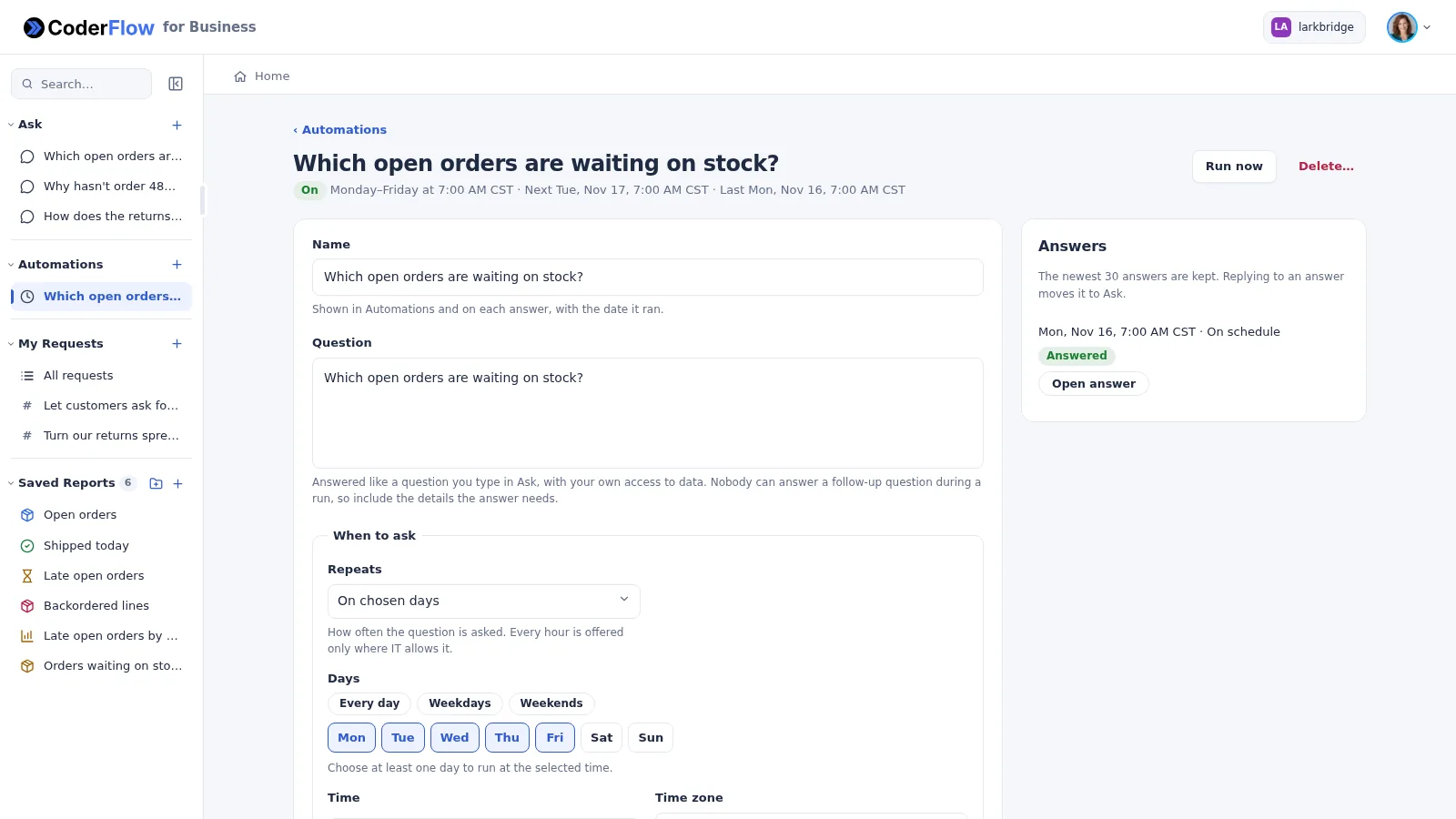
How It Connects
Agents work on source in Linux containers. Builds and tests run on OpenVMS through a connected system or your team.
Keep It, or Move Forward
Keep the system running while you understand it fully, then decide whether to stay, port or move.
A Silent Failure, Found
Accounting finds a gap in posted invoices. Ask traces it to the nightly job that only checks its first step. IT has an agent add checks and alerts to every step, then reviews and deploys the change.
Walkthroughs for your system are coming. Meanwhile, explore CoderFlow on a web app, or see how it works in the 2-minute quick look.
OpenVMS Questions
Can CoderFlow Document OpenVMS Applications, and Which Languages Does It Handle?
CoderFlow reads COBOL, Fortran, BASIC, Pascal, C and DCL command procedures, and documents programs together with the jobs and schedules that run them, with sources. That map is the starting point whether you keep the system, port it or move it.
How Does CoderFlow Connect to OpenVMS, and Who Builds the Changes?
Source and command procedures go into Git, and agents change them in Linux containers, where OpenVMS compilers can't run. Your team builds and tests on OpenVMS, or an SSH connection to a test system lets agents run builds there.
Can Business Users Ask CoderFlow About Our OpenVMS Applications?
In CoderFlow for Business, Ask answers plain-language questions, such as what happens when a nightly job fails, from the source, DCL and documentation, with sources listed. OpenVMS data can feed reports through web APIs your IT team exposes.
Can CoderFlow Help Us Port off OpenVMS?
CoderFlow documents the system fully first, including DCL jobs and the dependencies between programs. Agents can then help port programs to Linux one piece at a time, with your team reviewing every change and testing each step.
How Do We Get Started With CoderFlow for OpenVMS?
Copy your OpenVMS source and DCL procedures into Git and have CoderFlow document one application, then connect an OpenVMS build system over SSH when you want agents to build. Talk to sales about the full platform, or a Reimagine engagement to plan a port.
Is OpenVMS a Legacy System, and Can CoderFlow Modernize It Without a Rewrite?
CoderFlow works on what you already have, with no migration and no starting over. It documents COBOL, Fortran, BASIC, Pascal and DCL source, and agents prepare changes your team builds and tests on VMS, or runs over SSH on a test system.
Related systems
Industries where we often see OpenVMS
Bring AI to Your OpenVMS Applications.
Talk to sales about your setup, or start with a Reimagine engagement.