CoderFlow keeps you out of AI vendor lock-in by separating the platform from the agent. It runs AI coding agents such as Claude, Codex, and Gemini in isolated containers, against your own repositories, on infrastructure you control, and returns their work as changes you review and approve. You choose the agent per environment or per task, and your repositories, standards, access rules, and review process stay where they are when you switch.
One Board for Every Task in Flight
Describe the work in plain language, then choose the environment and the agent. CoderFlow launches that agent in an isolated container, where it clones the repositories it is entitled to, does the work, runs your build and test steps, and hands back a diff.
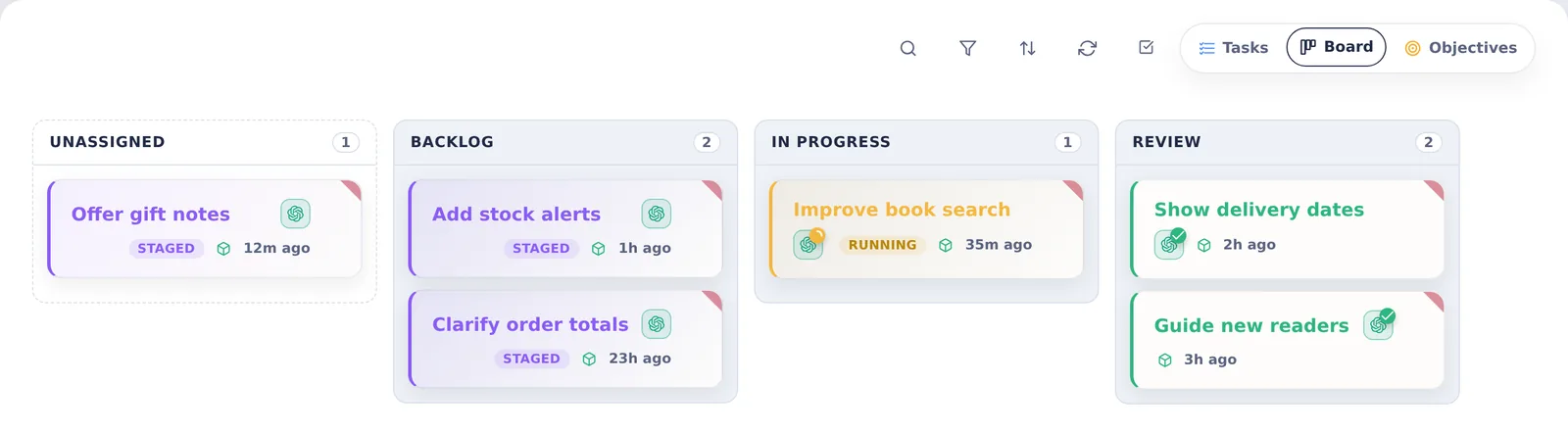
Every task becomes a card on one board, tasks run in parallel on whichever agent suits each, and one customer has run 1,800 tasks through CoderFlow. You can even run the same task on several agents and compare the results: the choice of agent is a decision you make on every task, not a contract you signed once.
Nothing Merges Without Approval
When a task finishes, the agent hands back a plain-language summary of what it found and why, plus the exact change set to review like any pull request. Nothing reaches your codebase until a person approves it, and one command applies it to your working copy.
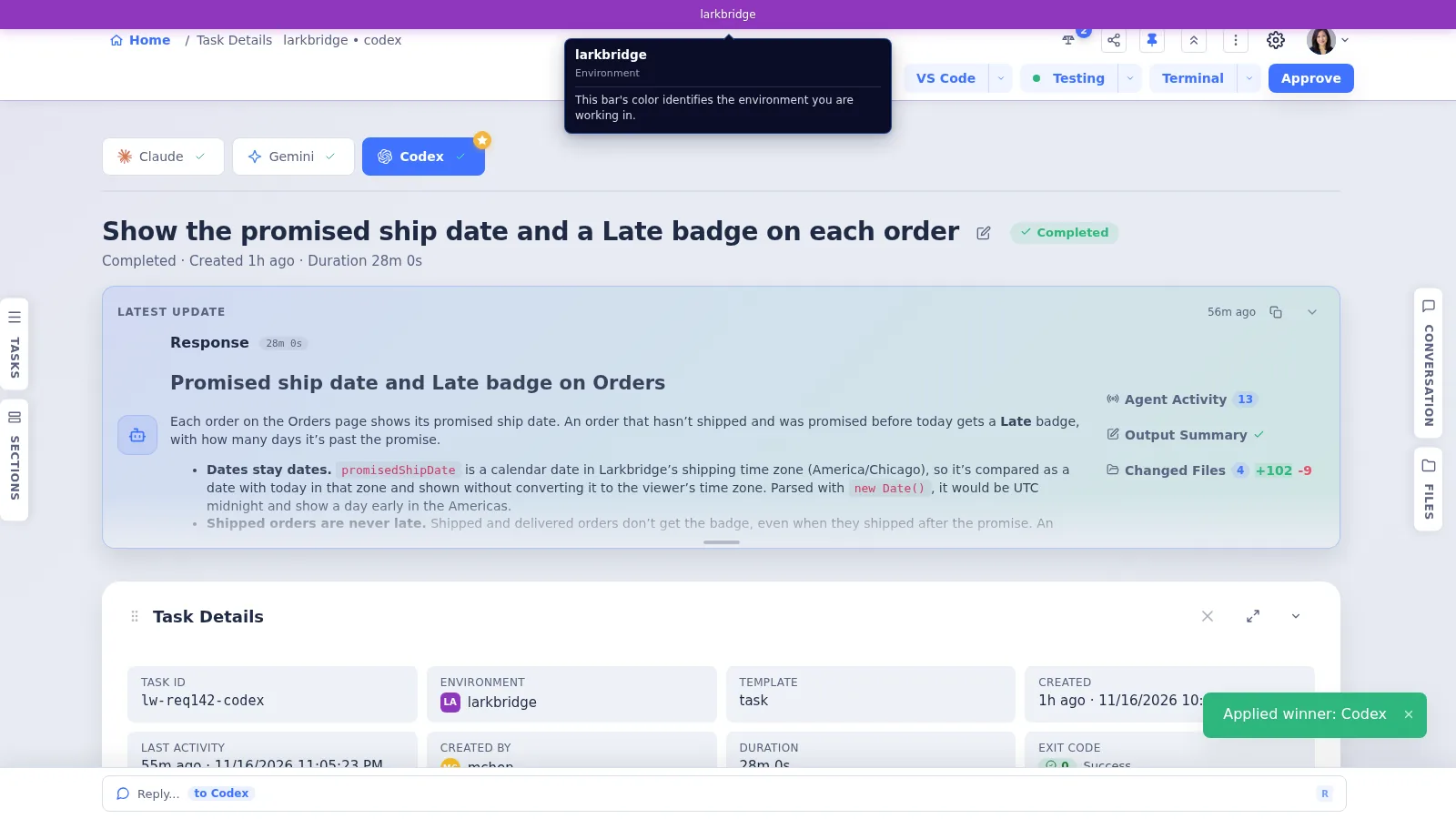
Picture an agent tracing a production error in a Visual FoxPro billing module, correcting the logic, and adding regression tests. The agent does the work, and you keep the final say.
Configured for Your Stack
In CoderFlow, an environment bundles everything a task needs, and each project or team gets its own:
- Repos the agent is allowed to touch.
- Instructions: your conventions and coding standards, written once.
- Secrets, managed centrally, encrypted at rest, and given to tasks only where you choose.
- Build, deploy, and test steps that run before an agent hands its work back.
- Default agent for the project, unless a task says otherwise.
Because this context belongs to the environment rather than to an AI vendor, changing the default agent changes nothing else.
Governed Access and Full History
Access is managed through users, teams, and roles, and each team is bound to the environments it is entitled to, so a contractor can be limited to one repository. With per-environment secrets and a fresh container for every task, CoderFlow is straightforward to put in front of a security review.
You can browse the commit history of any repository and inspect any change line by line, with agents' commits alongside everyone else's. If your code isn't in version control yet, getting it into Git is a natural first step.
Measurable Output, Not Promises
CoderFlow reports how many tasks ran, how often they succeeded, and the net lines of code they contributed. The reporting is agent-neutral, so a new agent is measured with the same yardstick as everything else.
Running CoderFlow on Your Own Stack
The CoderFlow server runs on your infrastructure, and agents never share state between tasks. Long-lived Git credentials stay on the server; containers get short-lived tokens for each Git operation.
The AI landscape will keep shifting, but the systems that run your business don't have to shift with it. Talk to sales, see the platform page, or start with a Reimagine engagement.
Questions
How Does CoderFlow Avoid AI Vendor Lock-In?
CoderFlow makes the AI agent a setting, not the foundation, and supports Claude, Codex, Gemini, IBM Bob, Grok, Kimi and more. Your repositories, environments, skills, access controls and approval process stay the same when you change agents.
Can CoderFlow Use Amazon Bedrock, Azure OpenAI or Self-Hosted AI Models?
CoderFlow supports custom endpoints including Amazon Bedrock, Azure OpenAI, OpenAI-compatible and Anthropic-compatible gateways, and Microsoft Foundry for Claude, and self-hosted models through LM Studio or a LiteLLM proxy. Local models aren't production-grade for heavy coding work, and IT chooses which provider accounts exist.
Where Does CoderFlow Run, and How Are Credentials Handled?
CoderFlow runs on your own Linux server with Docker, on premises or in your cloud, or is hosted by Profound Logic. Each task gets a fresh container with short-lived Git tokens, while AI provider keys and secrets you assign to tasks are available inside it and stored secrets are encrypted at rest.