CoderFlow makes autonomous AI agents safe for enterprise use by keeping all execution inside your infrastructure when self-hosted. Agents build, test and query databases in isolated containers on your network, and the code and data they read go only to the AI provider IT configured. Role-based access, audit trails, governed skills and human approval keep IT in control while agents do real futurization work on custom systems.
This is Part 2 of our series, Orchestrated Execution for Enterprise Development with CoderFlow. Part 1 covered how orchestrated execution builds on the coding agents your team already uses; here we cover the security architecture and the capabilities that put it to work.
Security: Autonomous Without Compromise
When CoderFlow is self-hosted, all agent execution happens inside your infrastructure, on premises or in a private cloud. The only cloud component is the call to the large language model, which can be your own gateway or a self-hosted model. Agents send concise snippets or questions to the model and carry out every action locally, so models never touch your repositories, databases or servers directly.
- Containerized isolation. Every task runs in its own container with least-privilege permissions, and containers are removed after a retention period (7 days by default).
- Controlled access. Agents reach your systems through channels your team configures, such as SSH with restricted accounts and database access with controlled credentials, never access granted by a cloud model.
- Governance built in. Role-based access separates administrators from users who start tasks. Task history keeps instructions, activity, logs and diffs, and every approval records who approved and when.
Read the full CoderFlow security overview for details.
Skills: Extending What Agents Can Do, Safely
A skill combines instructions for how to do something with the tools needed to do it. A skill for building a COBOL application carries the compile process and the ability to invoke the compiler; a skill for a React front end carries UX standards and CSS rules instead.
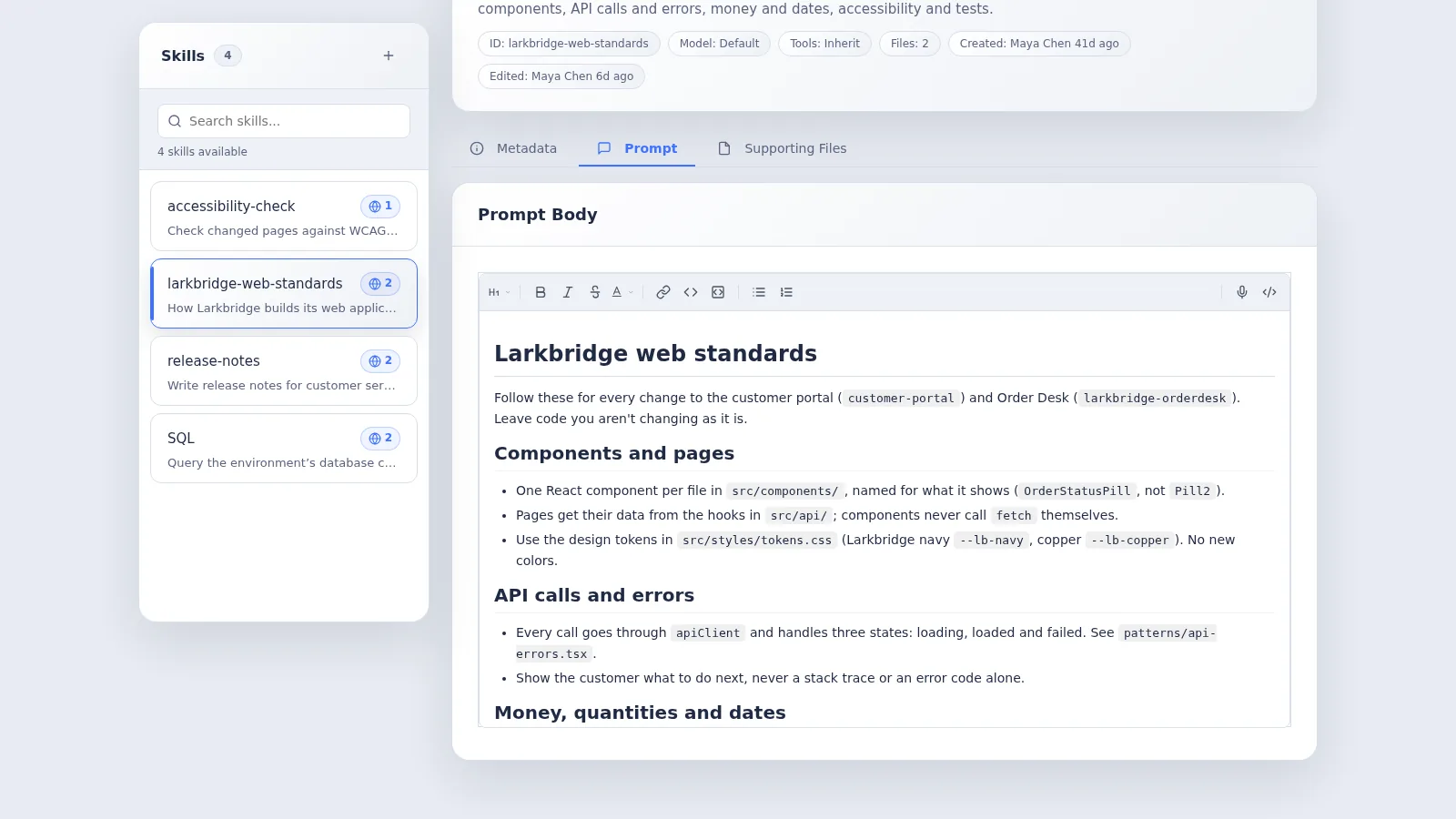
- Built-in and custom skills. CoderFlow ships its own skills, and teams add theirs from catalogs, NPM packages or Git repositories, or upload them directly.
- Dynamic loading. Skills load only when a task needs them, which keeps agents focused, and they're managed centrally.
- Security controls. Skills can be system-level, read-only or restricted to specific teams or projects.
- Browser automation. Playwright lets agents operate Chromium, capture screenshots and validate UI behavior.
Futurizing Custom Systems
Teams running mission-critical custom applications face retiring developers, technical debt and pressure to deliver faster. CoderFlow puts agents to work on each, with your team approving every change:
- Restructuring code, such as breaking monolithic Delphi units or large COBOL, VB6 or Visual FoxPro routines into modules, with behavior checked where your toolchain allows.
- Refactoring data access from record-level file operations to SQL, which opens the door to reporting and analytics.
- New interfaces on existing logic, which keeps running where it runs today. See interface reimagining.
- Parallel bug resolution, with agents in parallel containers each fixing a different issue and preparing commits for approval.
- Documentation of business rules and dependencies for developers and business users. See documentation with CoderFlow.
Modern Stacks Alongside Older Code
CoderFlow also supports Node.js, Java, Python, .NET and any language that benefits from automated build, test and validation. For React, Angular and other front ends, agents use Playwright to catch visual regressions, check responsive layouts and verify accessibility. Multi-repository orchestration lets agents make coordinated changes across front end, services, migrations and shared libraries.
What's Next in This Series
In Part 3: Implementation and Business Value, we cover how to measure CoderFlow's value, a staged adoption path that keeps risk low, and why timing matters. Want to see this on your system? Talk to sales or start with a Reimagine engagement.
Questions
Does Source Code Leave My Network When CoderFlow Agents Work on It?
When CoderFlow is self-hosted, repositories, builds, tests and data stay on your server, and agents send only the snippets and questions a task needs to the AI providers IT configures. Self-hosted models are an option, though the server still needs outbound internet access, so fully air-gapped operation isn't available.
How Does CoderFlow Control What AI Agents Can Access?
CoderFlow runs each task in its own Docker container as a non-root user, and IT decides which repositories, connections and secrets an environment includes. Roles control who can launch and approve work, and every approval is recorded.
Can CoderFlow Be Used in Regulated Industries Like Finance or Healthcare?
CoderFlow lets IT decide where it runs, which AI providers are allowed, what agents can reach and who approves changes, with an audit trail of approvals and full task history. CoderFlow doesn't claim compliance certifications, so talk to sales about your requirements.