
Before AI agents change your production code, you need clear answers on isolation, credentials, permissions, approvals, AI providers and traceability. Use the 12 questions below as a checklist for any AI agent platform. For each, here is how CoderFlow answers, including where it falls short today.
Why Do AI Agents Need Their Own Governance?
Coding agents such as Claude Code and Codex work on their own for minutes or hours, so they need the controls you would put around a new contractor, applied to every task. Gartner predicts that over 40% of agentic AI projects will be canceled by the end of 2027, partly because of inadequate risk controls (Gartner, June 2025).
Where Does the Work Run, and What Can It Reach?
1. Does Each Agent Task Run in Its Own Isolated Workspace?
CoderFlow: each task runs in its own Docker container as a non-root user, with resource limits and ports reached only through an authenticated proxy.
2. What Credentials Can the Agent See?
CoderFlow: no long-lived Git credentials in the workspace, only short-lived tokens per Git operation, limited to the task's repositories. AI provider credentials, connection credentials and secrets marked for tasks are visible to that environment's agents.
3. Which Repositories and Systems Can It Reach?
CoderFlow: IT-defined environments, versioned in Git, list the repositories, connections and secrets a task gets, and repositories can be read-only.
4. Can Anything Reach Production Without a Person?
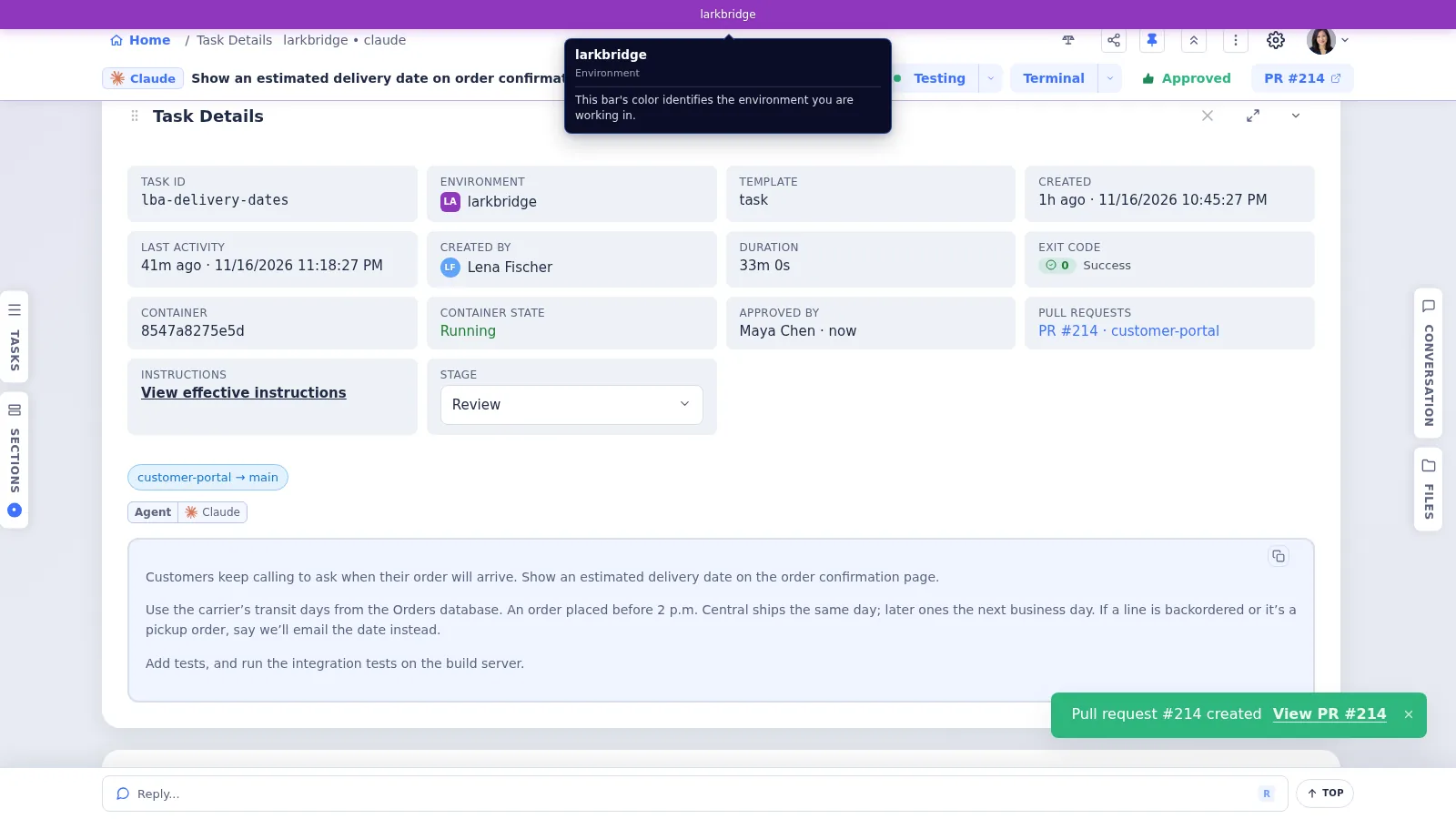
CoderFlow: a person approves every change, including changes from scheduled automations, as a commit, push, branch or pull request, and protected branches block direct pushes.
Who Can Act, and How Is the Work Checked?
5. Does It Use Your Identity Provider and MFA?
CoderFlow: SSO through OpenID Connect with presets for Microsoft Entra ID, Okta and Google Workspace, an SSO-only mode, and authenticator-app MFA for local accounts.
6. Can You Separate Who Launches Work From Who Approves It?
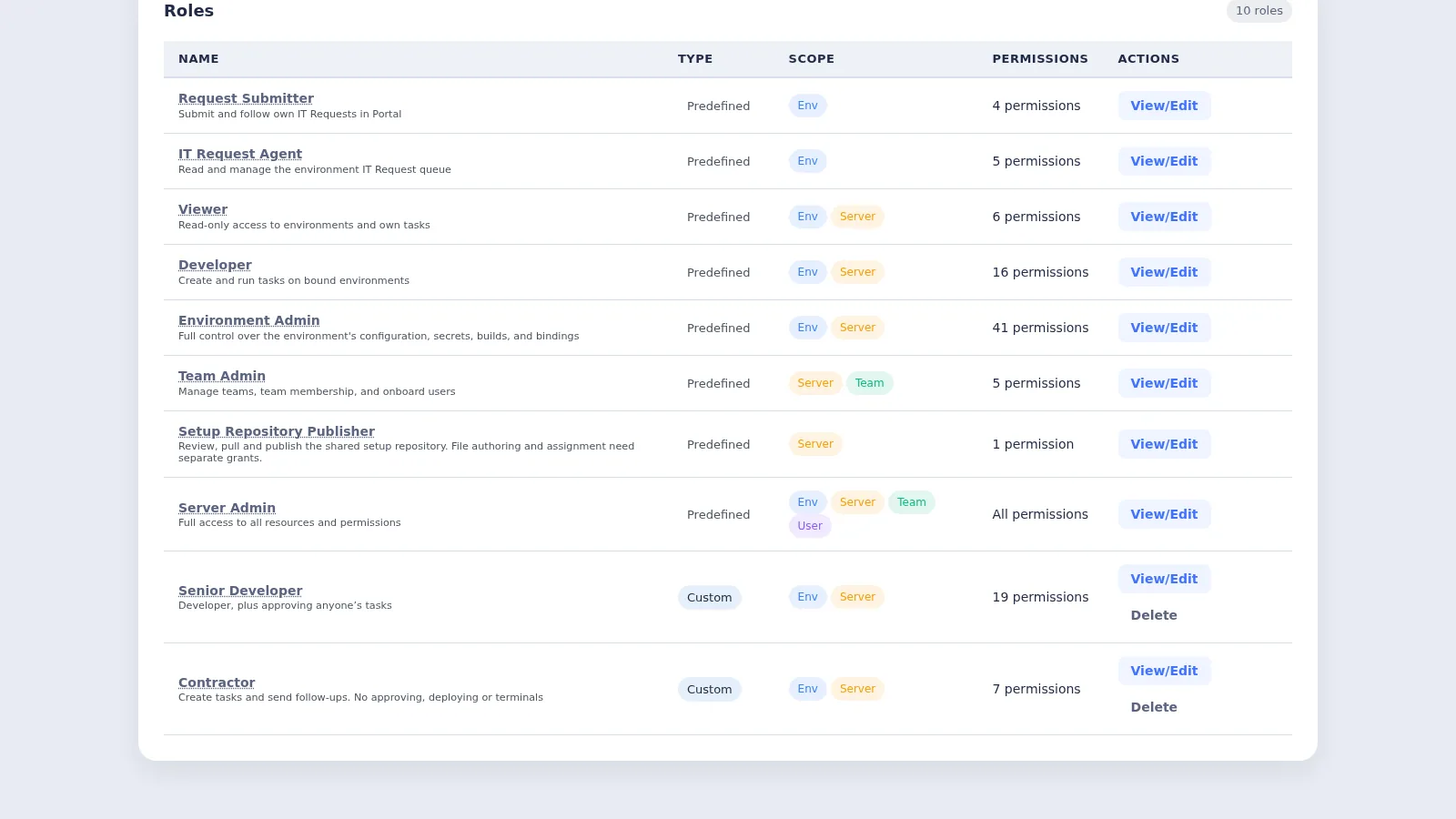
CoderFlow: predefined and custom roles, bound to users or teams per environment. Delegated admins can only grant permissions they hold.
7. Does the Agent Test Its Own Work Before Review?
CoderFlow: agents run your builds and tests in the container or on build servers over SSH, with Playwright built in. Judges return verdicts but never approve anything.
8. Can Reviewers See What Changed and Why?
CoderFlow: each task shows the diff, summary, test output, screenshots and logs.
Which AI Is Used, and Can You Prove What Happened?
9. Who Chooses the AI Providers and Models?
CoderFlow: IT does. Agents include Claude, Codex, Gemini, Bob, Grok and Kimi, plus Amazon Bedrock, Azure OpenAI, gateways and self-hosted models, and a provider with no account can't be used.
10. Where Does Your Code Go?
CoderFlow: self-hosted on your own Linux server or hosted by Profound Logic on CoderFlow Cloud. Code an agent reads goes to the AI provider IT configured.
11. Can You Trace Every Change to a Request and a Person?
CoderFlow: every approval records who approved, when, the commit message, the commits and the push status. Task history outlives the container.
12. Can You Control Capacity and Cost?
CoderFlow: a default limit of 8 concurrent agents, token usage per task and a usage dashboard.
How CoderFlow Helps
CoderFlow is built so IT stays in control of agents that change real code. See security and governance, the security overview, CoderFlow for IT, enterprise, change management built for agents and our guide to change management for AI agents.
What Should You Watch out For?
- Certifications. CoderFlow doesn't list compliance certifications today.
- Network access. Fully air-gapped operation isn't available; the server needs outbound internet access.
- Single sign-on. SSO uses OpenID Connect. SAML isn't supported today.
- Secrets. Anything marked for tasks is visible to that environment's agents.
- Audit and budgets. A permissions audit log is on the roadmap, and dollar budgets aren't available.
Ask for Evidence, Not Slides
Ask every platform to show each answer in the product, as the IT governance walkthrough does in about 5 minutes. Reviewing it with your security team? Talk to sales.
Questions
What Should an AI Coding Agent Governance Checklist Include?
CoderFlow answers the core governance questions with isolated containers, short-lived Git tokens, roles, human approval and kept history. A checklist should cover isolation, credentials, who can launch and approve work, testing and review, AI providers and where code goes, and traceability.
Does CoderFlow Let AI Agents Commit Code Without Human Approval?
CoderFlow holds every change an agent prepares, including changes from scheduled automations, until a person reviews the diff and approves it as a commit, push, new branch or pull request. Each approval is recorded with who approved, when, the commit message and the commits it produced.
Does CoderFlow Have Compliance Certifications or an Air-Gapped Option?
CoderFlow can be self-hosted on your own Linux server, with SSO, role-based access, isolated tasks and recorded approvals, but it doesn't list compliance certifications today. Fully air-gapped operation isn't available, because the server needs outbound internet access for AI providers, Git hosts, package registries and licensing.