
AI coding agents are already very good at writing code. The hard part is everything after: testing the change against your systems, getting it reviewed and approved, releasing it, and connecting it to the rest of the business. Research on companies that adopted agents shows the work piling up there, and that is the part CoderFlow is built for.
What Today's Coding Agents Already Do
The leading agents have come a long way:
- Claude Code can split one large change across 5 to 30 agents and fix failing CI runs on its own.
- OpenAI Codex runs parallel cloud tasks and gives pull requests a first-pass review.
- GitHub Copilot runs the tests, the linter and CodeQL before it opens a pull request.
- Cursor cloud agents attach screenshots or video as evidence.
If your developers already use one of these agents, keep it.
The Evidence: The Work Piles Up After the Code
- Review becomes the bottleneck. In a Harvard job market paper, not yet peer reviewed, on Jellyfish data from 655 firms, pull requests rose an additional 35.7% after firms adopted AI agents. Resolved Jira issues rose only 13.7% (borderline significant), and time from review submission to approval rose 56.1% (Chen and Stratton, Harvard University, November 2026).
- Review time and incidents climb with adoption. In vendor data from Faros AI covering 22,000 developers, median time in review rose 441.5% from low to high AI adoption, and the ratio of incidents to pull requests rose 242.7% (Faros AI, April 2026).
- Verification is the new cost. InfoQ's coverage of Google's DORA report describes a "verification tax imposed by reviewing AI-generated code" (InfoQ, May 2026).
At Scoular, development sped up so much that testing became the constraint. "Now it's testers," said Brad McDaniel, IT Manager at Scoular. "We're able to put so much out."
The agents aren't weak; they are strong enough that the bottleneck has moved. CoderFlow runs the agents you choose, including Claude, Codex, Gemini, IBM Bob, Grok and Kimi, and handles everything after the code.
From Built to Shipped
CoderFlow verifies each change in an environment set up like yours, and QA agents can use the application the way a person would. Test output and screenshots come back with the change. See how CoderFlow tests changes.
Nothing is committed until a person approves it, and each approval is recorded. It goes out through your existing release process or through deployment steps IT defines in CoderFlow; running them takes permission, and every run is recorded. See change management built for agents.
With CoderFlow, Scoular now pushes 10 to 12 changes through each Tuesday and Thursday deployment window, up from 4 or 5.
Connected to What You Already Run
CoderFlow agents work with your existing applications, databases and homegrown software through APIs, MCP tools and connections IT configures. IT decides what each environment can reach, and business users see only the data their own access allows.
That matters when code can't leave your control: Scoular needed a server-based platform with read-only environments, not a desktop tool that needed source files copied to a laptop.
One Platform, Any Agent
CoderFlow runs Claude, Codex, Gemini, IBM Bob, Grok and Kimi under one set of controls, with any Git host, on CoderFlow Cloud, hosted by Profound Logic, or on your own server. One sign-in and one set of permissions cover development, testing, review, automations, reports and IT Requests. Read more about avoiding AI vendor lock-in.
Business and IT on the Same Work
In CoderFlow, business users direct agents too: they build reports and automations, ask questions about their data, and send IT Requests with their screen and context attached. IT turns those requests into agent work under its own rules and approves what ships. See CoderFlow for Business.
Scale Your Review Can Keep Up With
You can run hundreds of tasks from one template. They run in parallel within your server's capacity, AI judges can check each result, and they come to people for approval with the evidence attached. See how templates handle batch work at scale.
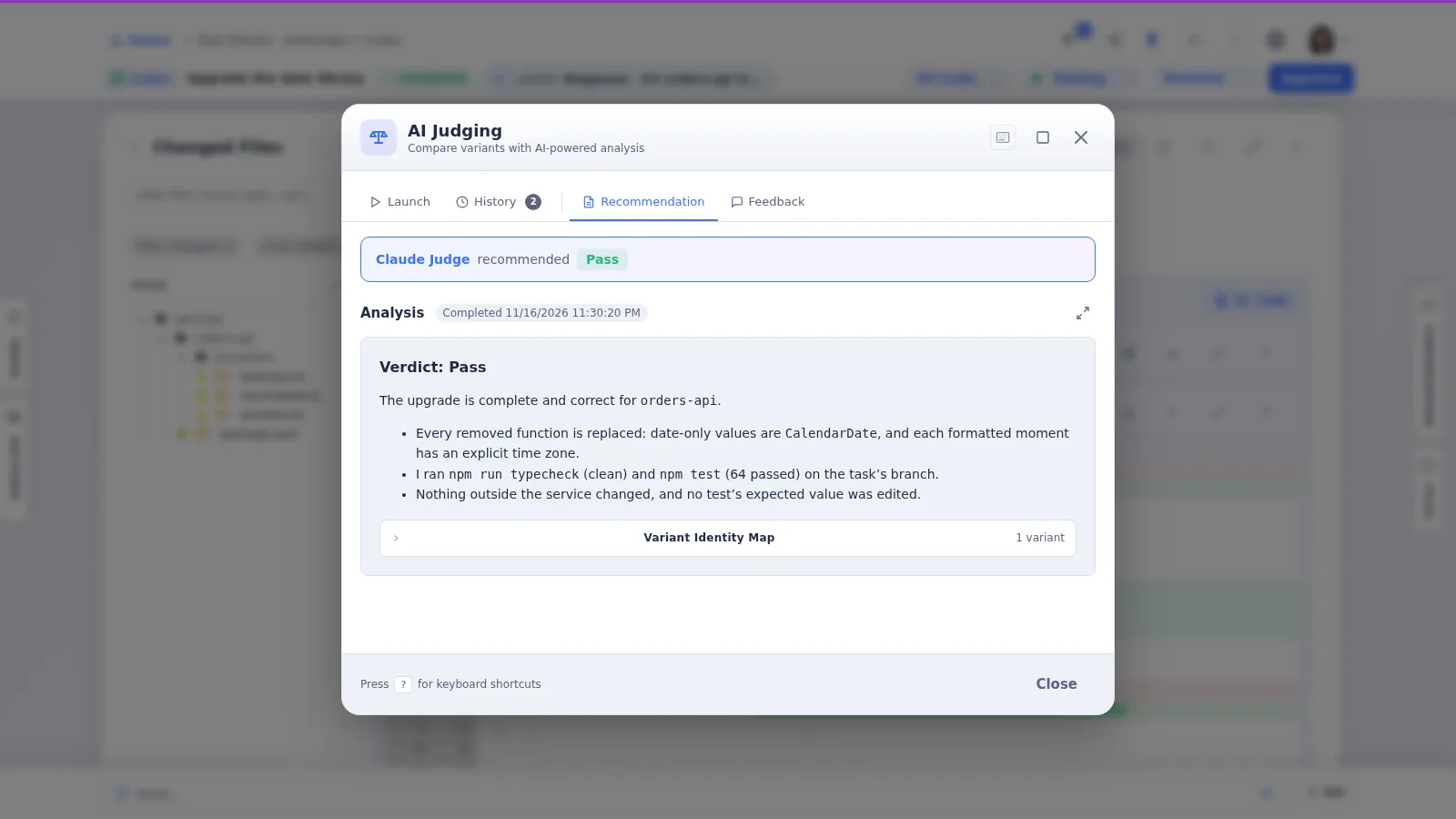
Scoular has run 1,800 tasks through CoderFlow, touching more than 5,200 files. Two projects planned at about 14 months were finished in under 2 months; those were planning estimates, not a controlled benchmark. Read the Scoular story.
Keep the Agents You Have
The question isn't which coding agent writes the best code, but what happens to that code next. CoderFlow handles everything after it, so your agents' work gets into production. Read our guide to coding agents and CoderFlow, or see the CoderFlow platform.
Questions
Are AI Coding Agents Like Claude Code and Codex Good Enough for Enterprise Work?
Leading agents are very good at writing code: they read a codebase, make changes, run tests and fix failures. CoderFlow handles what they leave to you: verification against your own systems, review and approval, release, and governance across agents and teams.
Why Hasn't Our Delivery Sped Up Since We Adopted AI Coding Agents?
The bottleneck has moved from writing code to reviewing, testing and releasing it; in a Harvard paper not yet peer reviewed, time from review submission to approval rose 56.1% after firms adopted agents. CoderFlow brings each change to review already verified, with its evidence attached.
Do We Have to Replace Our Coding Agent to Use CoderFlow?
CoderFlow runs Claude, Codex, Gemini, IBM Bob, Grok and Kimi under one set of controls, so you keep the agents you have. It adds what comes after the code: verification in an environment set up like yours, human approval, release and connections to your existing systems.
How Does CoderFlow Get Agent Changes Into Production Safely?
CoderFlow builds and tests each change in an environment set up like yours and brings it to a person with the diff, test output and screenshots. Nothing is committed until a person approves it, and the change ships through your existing release process or deployment steps IT defines.